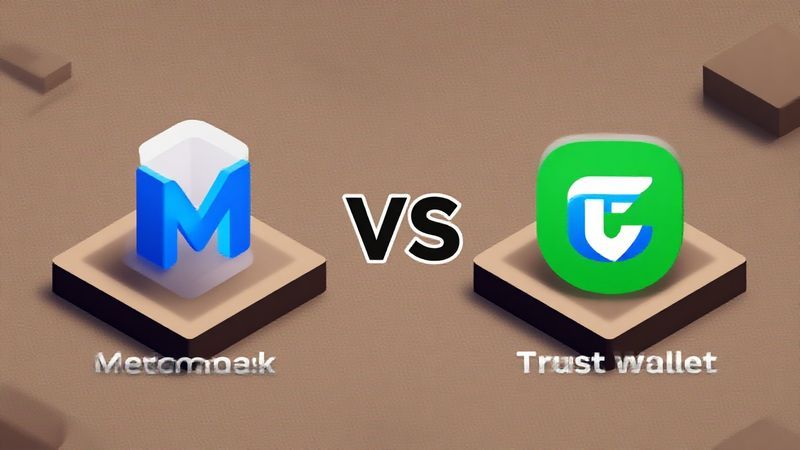
MetaMask vs Trust Wallet: Security and Features Comparison 2026
The rapidly evolving landscape of Web3 in 2026 demands sophisticated yet accessible tools for managing digital assets and interacting with decentralized applications (dApps). Self-custodial wallets serve as critical gateways to this ecosystem, empowering users with complete control over their private keys and, consequently, their funds. Among the myriad options available, MetaMask and Trust Wallet have consistently stood out as industry leaders. This article provides a comprehensive, academic comparison of these two prominent wallets, focusing on their security architectures, feature sets, and strategic positioning as we look ahead to 2026, offering insights for both new and experienced blockchain participants.
Introduction to Self-Custodial Wallets
Self-custodial wallets are foundational components of the decentralized web, enabling users to store, send, and receive cryptocurrencies and NFTs without relying on third-party intermediaries. Unlike custodial solutions, where a service provider holds the private keys, self-custodial wallets place the responsibility squarely on the user. This paradigm shift offers unparalleled autonomy but necessitates a robust understanding of security principles. As the blockchain space continues to mature by 2026, the demand for versatile, secure, and user-friendly wallets that can adapt to new protocols and evolving threats is paramount.
MetaMask Overview
Developed by ConsenSys, MetaMask has long been the quintessential browser extension wallet, serving as the primary interface for interacting with the Ethereum blockchain and a vast array of EVM-compatible networks (e.g., Polygon, Binance Smart Chain, Arbitrum, Optimism). While primarily known for its desktop browser integration, MetaMask has significantly expanded its mobile application capabilities, offering a consistent experience across platforms. Its strength lies in its widespread adoption among developers and dApp users, effectively becoming a standard for Web3 interaction. By 2026, MetaMask continues its trajectory as a critical infrastructure layer, benefiting from extensive community support and an increasingly modular design through initiatives like MetaMask Snaps.
Trust Wallet Overview
Trust Wallet, acquired by Binance in 2018, initially gained prominence as a mobile-first, multi-asset wallet. It offers broad support for a multitude of blockchains beyond the EVM ecosystem, including Solana, Cosmos, Polkadot, and more. Trust Wallet prioritizes an intuitive user experience, integrating features such as an in-app dApp browser, staking functionalities, and seamless crypto purchasing options directly within its interface. Its strong focus on mobile accessibility and comprehensive asset support has made it a favorite for users seeking an all-in-one solution for managing diverse crypto portfolios on the go.
Security Features Comparison
Security remains the paramount concern for any self-custodial wallet. Both MetaMask and Trust Wallet employ industry-standard cryptographic practices, but their specific implementations, backing, and ongoing development contribute to distinct security profiles.
- Private Key Management: Both wallets operate on a non-custodial model, meaning users retain full control of their private keys, which are typically derived from a 12 or 24-word seed phrase (BIP-39 standard). These keys are encrypted and stored locally on the user’s device, never transmitted to wallet servers. The responsibility for securing the seed phrase—keeping it offline and undisclosed—rests entirely with the user, a critical constant even in 2026.
- Open Source and Audits:
- MetaMask: Large portions of MetaMask’s codebase are open source, allowing for community scrutiny and external security audits. Backed by ConsenSys, it undergoes regular professional security reviews, contributing to its robust security posture. Its widespread use also means it is constantly battle-tested by millions of users and developers.
- Trust Wallet: Trust Wallet also leverages open-source components and undergoes frequent security audits by reputable third-party firms. Its affiliation with Binance provides access to significant security expertise and infrastructure, though some argue this introduces a degree of centralization risk compared to more purely community-driven projects.
- Hardware Wallet Integration: For enhanced security, both wallets offer robust integration with leading hardware wallets like Ledger and Trezor. This allows private keys to remain offline on the hardware device, requiring physical confirmation for transactions. This feature is highly recommended for storing significant assets and is a critical security layer that will remain vital in 2026.
- Transaction Signing and Permissions: Both wallets require explicit user confirmation for every transaction, displaying transaction details for review. They also manage dApp permissions, allowing users to approve or revoke access to their wallet. By 2026, as sophisticated phishing and contract exploits evolve, both wallets continually update their interfaces to provide clearer warnings and more granular control over these permissions.
- Biometric Authentication: For mobile users, both MetaMask and Trust Wallet support biometric authentication (fingerprint, facial recognition) to unlock the app and authorize certain actions, adding a convenient layer of security against unauthorized access to the device.
- Phishing Protection and Scam Warnings: While both wallets aim to protect users, the primary defense against phishing and malicious dApps remains user vigilance. However, ongoing improvements in both wallets include displaying clearer warnings for suspicious URLs or unverified contracts, a feature that will become increasingly sophisticated by 2026 through community reporting and automated threat intelligence.
Features Comparison
Beyond security, the utility and feature set of a wallet determine its suitability for different user types.
- Supported Blockchains and Assets:
- MetaMask: Traditionally strong in the EVM ecosystem, MetaMask natively supports Ethereum and all EVM-compatible chains. By 2026, its “Snaps” feature is poised to significantly expand its capabilities beyond EVM, allowing integration with non-EVM blockchains (e.g., Bitcoin, Solana) and new cryptographic schemes through third-party plugins. It natively supports ERC-20 tokens, NFTs (ERC-721, ERC-1155), and custom tokens.
- Trust Wallet: Trust Wallet excels in its native multi-chain support, offering out-of-the-box compatibility with a much broader range of non-EVM blockchains and their respective tokens and NFTs. This includes not just EVM chains but also Solana, Polkadot, Cosmos, TRON, and many more. This comprehensive support simplifies portfolio management for users with diverse holdings.
- User Interface and Experience:
- MetaMask: Known for its browser extension, MetaMask offers a functional and efficient interface for desktop dApp interaction. Its mobile app has significantly improved, offering a comparable experience. It caters to users who frequently interact with dApps and prefer a desktop-centric workflow.
- Trust Wallet: Trust Wallet shines with its mobile-first design philosophy. Its interface is highly intuitive, clean, and user-friendly, making it ideal for beginners and those who primarily manage their crypto on smartphones. The integrated dApp browser within the mobile app offers a seamless experience.
- DApp Browser/Integration:
- MetaMask: Connects to dApps primarily by injecting Web3 providers into the browser environment, allowing dApps to directly interact with the wallet. WalletConnect provides mobile dApp connectivity.
- Trust Wallet: Features a built-in dApp browser directly within its mobile application, offering a curated and often smoother experience for discovering and interacting with decentralized applications on mobile devices.
- Staking and Earning Features:
- MetaMask: Does not offer direct in-app staking. Users must connect to external staking dApps (e.g., Lido, Rocket Pool) to earn yields.
- Trust Wallet: Provides direct in-app staking for several proof-of-stake cryptocurrencies, allowing users to earn passive income without leaving the wallet environment. This is a significant convenience factor for many users.
- Integrated Swaps and Fiat On/Off-Ramps: Both wallets offer integrated token swap functionalities, leveraging decentralized exchanges and aggregators to find competitive rates. They also typically include options to buy crypto with fiat currency directly within the app, simplifying the onboarding process for new users. These features are expected to become even more streamlined and efficient by 2026.
- NFT Support: Both wallets provide robust support for viewing, sending, and receiving NFTs across supported chains, with improving interfaces for managing digital collectibles.
Advanced Features and Ecosystem Integration for 2026
The trajectory towards 2026 sees both wallets adapting to and shaping the future of Web3:
- MetaMask Snaps: This modular architecture is a significant differentiator for MetaMask’s future. Snaps enable developers to build custom functionalities, expanding MetaMask’s capabilities to include non-EVM chains, new transaction types (e.g., Bitcoin Taproot), enhanced privacy features, and custom security warnings. This extensibility positions MetaMask to remain at the forefront of innovation.
- Web3 Standards and Interoperability: Both wallets are committed to supporting evolving Web3 standards, including WalletConnect for universal dApp interaction and potential integrations with decentralized identity (DID) frameworks. As the blockchain ecosystem becomes increasingly interconnected, their ability to facilitate seamless cross-chain and cross-application experiences will be crucial.
- Privacy Enhancements: Expect continued focus on privacy-preserving features. While core transactions are public, both wallets may explore integrations with privacy-focused scaling solutions or privacy-enhancing technologies to offer users more control over their transaction data.
Conclusion
In the dynamic landscape of 2026, the choice between MetaMask and Trust Wallet largely hinges on individual user preferences, primary blockchain interactions, and desired feature sets.
MetaMask remains the preferred choice for power users, developers, and those deeply integrated into the EVM ecosystem. Its strong browser extension, widespread dApp compatibility, and the transformative potential of MetaMask Snaps position it as a highly extensible and future-proof gateway to Web3. Users who prioritize a desktop experience and engage frequently with a variety of dApps will find MetaMask invaluable.
Trust Wallet excels as an intuitive, mobile-first solution for users who require broad multi-chain support and prefer an integrated experience for managing diverse crypto portfolios, staking, and basic dApp interaction. Its ease of use and comprehensive asset coverage make it an excellent choice for beginners and those who primarily interact with crypto via their smartphone. Its Binance backing provides a layer of institutional stability and robust security infrastructure.
Ultimately, both wallets are highly secure when proper user practices are observed (e.g., securing seed phrases, using hardware wallets for significant assets, exercising caution with dApp connections). As the Web3 space continues its rapid expansion, both MetaMask and Trust Wallet are well-positioned to evolve, offering robust, secure, and feature-rich experiences for the discerning digital asset holder in 2026 and beyond.
Disclaimer: This content is for educational purposes only. Not financial advice.